

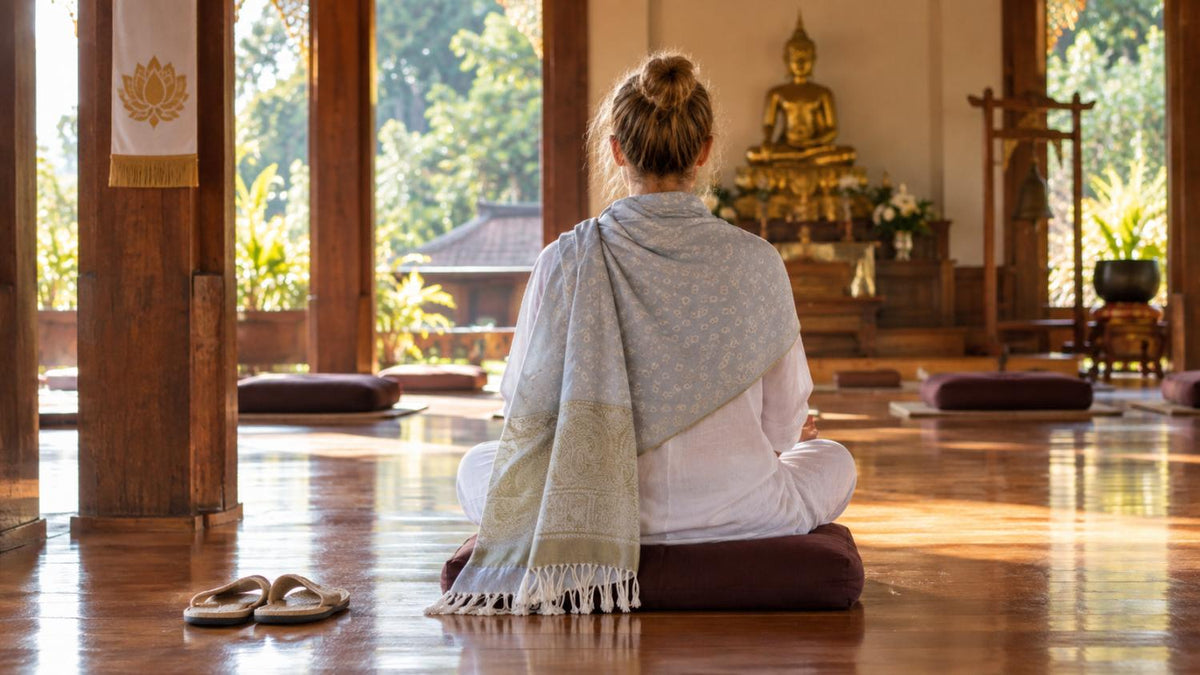
A meditation retreat is not an ordinary vacation. Many things that usually seem important while traveling take a back seat for a few days. The daily rhythm becomes simpler, external distractions diminish, and attention increasingly turns inward.
From our many years of experience with monastery, meditation, and retreat trips, we know that you don't need much for such a journey. However, some things can make the days at the retreat significantly more pleasant.
There is one important principle:
Always check the rules of the respective monastery or retreat center before packing.
What might be useful for a freely designed meditation trip may be explicitly not intended or even not allowed at another retreat. This applies, for example, to clothing, smartphones, books, notebooks, malas, or personal spiritual items.
A meditation shawl – one of the most important companions
In a meditation hall, you often sit for a long time and move little. Even in warm countries, you can get chilly – due to air conditioning, cool mornings, or simply because the body calms down during a long meditation.
From our travel experience, a large meditation shawl is therefore one of the things we wouldn't want to miss on a meditation trip.
You can drape it over your shoulders, pull it over your legs, or wrap yourself in it during a longer sitting meditation. This wrapping can be particularly pleasant: the shawl provides warmth and simultaneously creates a small personal space around your body.
It takes up little space in your luggage and can also be used well during the journey.
At AlayaSol, you'll find different variations – from a cream-white meditation shawl to a red meditation shawl to a lighter wool and silk meditation blanket.
Which variant you choose is less important than the question: Do you feel warm and comfortable with it when you sit still for a long time?
Comfortable clothing, warm feet, and an appropriate sitting posture
On a meditation trip, clothing must primarily do one thing: you should be able to sit in it for a long time without anything cutting in, constricting, or restricting your movement.
Loose-fitting pants are therefore ideal. Meditation pants in Thai style offer a lot of freedom of movement. Comfortable yoga pants with a soft waistband can also work well.
Pants with long cuffs at the legs are particularly practical. If you get chilly during a longer meditation or want to cover your feet, you can simply pull the cuffs over your feet. A pair of warm yoga socks is therefore one of the things that have proven effective for us during early morning meditations or longer sitting sessions.
Especially during a retreat in a Buddhist monastery, in addition to comfort, a respectful sitting posture also plays a role. The soles of the feet should not be directed towards Buddha depictions, monks, or other people. Therefore, make sure to adopt an appropriate sitting posture even during longer meditations.
Comfortable, sufficiently wide clothing supports you in this. You can change your sitting position, adjust your legs differently, or cover your feet without your clothing restricting you.
The dress code of the respective location is also important. For Vipassana retreats in Thailand, for example, completely white clothing may be mandatory.
Comfort, withdrawal, and respect go hand in hand when it comes to clothing for a meditation trip.
Flip-flops or simple sandals – quick in, quick out
On a meditation trip, flip-flops or simple sandals are an absolute must in your luggage. You will probably put your shoes on and take them off much more often than on a normal trip.
Shoes are left outside the meditation hall, temple rooms, and, depending on the accommodation, also outside other indoor areas. If you are going back and forth between your room, the dining hall, and the meditation hall several times a day, it is extremely practical to simply slip them on and off just as quickly.
Flip-flops or sandals are a small item in your luggage – at the retreat, you'll be glad to have them.
Do I need my own meditation cushion or meditation stool?
Before you pack a large meditation cushion in your suitcase: First ask the retreat center.
Many centers provide meditation cushions and other sitting aids. If everything is available there and you can sit comfortably with it, there's no reason to take extra luggage.
However, if you know that you can meditate particularly well on a specific seat or experience discomfort during longer sitting sessions, your own sitting aid can be useful.
For travel, a foldable meditation stool is particularly practical. It takes up less space than a rigid meditation bench and allows you to maintain your familiar sitting position even while traveling.
Especially with several hours of meditation a day, you should not underestimate a suitable sitting position for you.
A meditation timer – keeping track of time without a smartphone
During a meditation retreat, the smartphone stays out. This conscious break from news, social media, and constant availability can be a beneficial digital detox and helps to truly focus attention on meditation and the time at the retreat.
Nevertheless, it doesn't work completely without a clock. A retreat usually has a clear daily structure with fixed times. The day often begins early in the morning, with meditations, meals, and breaks following a fixed rhythm. Punctuality is important, as the group practices together and the daily schedule builds upon each other.
A clock or an alarm clock therefore helps you to get up on time in the morning and also to keep track of time during the day, without having to reach for your smartphone.
For your own meditation times, a small meditation timer is also practical. You set how long you want to sit before you start, and you don't have to think about how much time has passed during the meditation.
The KABANI meditation timer is particularly suitable for this. It can be used with an alarm sound, vibration, or LED light and also offers a silent mode. This way, you can end your meditation session without disturbing other people in the room with a loud signal.
Due to its light weight, it can be easily taken in your travel luggage.
Be considerate – no intense scents
On a meditation trip, you often sit relatively close to other people for extended periods. A strong perfume or intensely scented body care product can quickly be distracting in a meditation hall.
For the duration of the retreat, we therefore recommend subtle or as fragrance-neutral as possible care products: a mild soap, a neutral deodorant, and a simple body lotion, for example, aloe vera gel. You should avoid perfume and intense scents during these days.
This also shows consideration for the people with whom you share this quiet space.
Mala, notebook, and a personal anchor – check retreat rules beforehand
A mala can be a wonderful companion for your own mantra practice. A small notebook can help you capture thoughts, experiences, or insights. And a small Buddha or another personal symbol can remind you why you embarked on this journey in the first place.
But precisely at this point, the distinction between different meditation journeys is particularly important.
In a free retreat or a self-designed meditation trip, these things can fit your practice very well. However, different rules may apply in a Vipassana retreat. Personal spiritual items, malas, books, or writing materials may be undesirable or not allowed during the retreat period so that attention remains entirely on the respective meditation practice.
Therefore, here too:
Do not automatically bring your usual spiritual practice into a retreat. Embrace the practice of the place.
When the meditation journey gets difficult
This point is an absolute must for us in this guide.
A meditation retreat can be wonderful. But it can also be strenuous.
When external distractions disappear and you spend many hours with yourself, resistances such as boredom, frustration, sadness, or anger can arise. Perhaps at some point, the simple thought will also come up:
I don't feel like it anymore.
From our experience with meditation and monastery retreats, we know that such phases can also be part of an intense retreat experience. Often, something changes after the first difficult days. However, this cannot be fixed to a specific day and will be different for everyone.
Precisely for this reason, it can be helpful to become aware of why you are going before the trip.
In a retreat that allows personal items, a small brass Buddha or another symbol can become a personal anchor. Not as decoration and not as a good luck charm that does the work for you. But as a reminder:
I consciously chose this time.
If personal items are not allowed, you can write down your intention before the trip or discuss it with someone who knows why this experience is important to you.
Then your anchor travels with you anyway, in a sense – just not in your suitcase.
A meditation retreat is reduced to the essentials
A meditation retreat is a time of reduction. Externalities, self-presentation, and the constant distraction from smartphones, news, and social media stay outside for a few days.
Attention turns inward. This requires discipline and endurance, because difficult phases are also part of an intense meditation period. But this is precisely where the reward can lie: more clarity, a concentrated mind, and the experience of truly arriving at yourself.
This conscious decision for the essentials begins already when packing.
You not only decide what you take with you. You also decide what stays outside for a few days.


