
You want to buy a yoga mat and are wondering which one is right for you? Which thickness? Which material? And can't you just use a fitness mat for yoga?
A good yoga mat should support you during your practice. This is not just about a comfortable surface. Grip, stability, and good contact with the ground play a crucial role in yoga.
We will explain the most important differences and compare two yoga mats that we at AlayaSol particularly like to recommend: the YOGISTAR yogimat pro and the YOGISTAR yogimat sun.
Yoga mat or fitness mat – what's the difference?
At first glance, yoga and fitness mats look quite similar. Both are unrolled on the floor and provide a surface for movement and exercises.
The decisive difference lies in their function.
For fitness or gymnastics mats, cushioning plays a greater role. This is precisely what is desired for many floor exercises: the back, knees, or elbows should rest softly.
In contrast, for yoga, you need a firm and stable stance.
You don't want to sink deeply into the mat, but rather feel the ground beneath you. Especially in standing asanas and balancing poses, this contact gives you stability and grounding.
Therefore, classic yoga mats are often about 4 to 6 mm thick, while fitness and gymnastics mats for more heavily cushioned floor exercises are often 10 to 15 mm. The boundaries are fluid, as even with fitness mats there are thinner and thicker models.
Why is grip so important for a yoga mat?
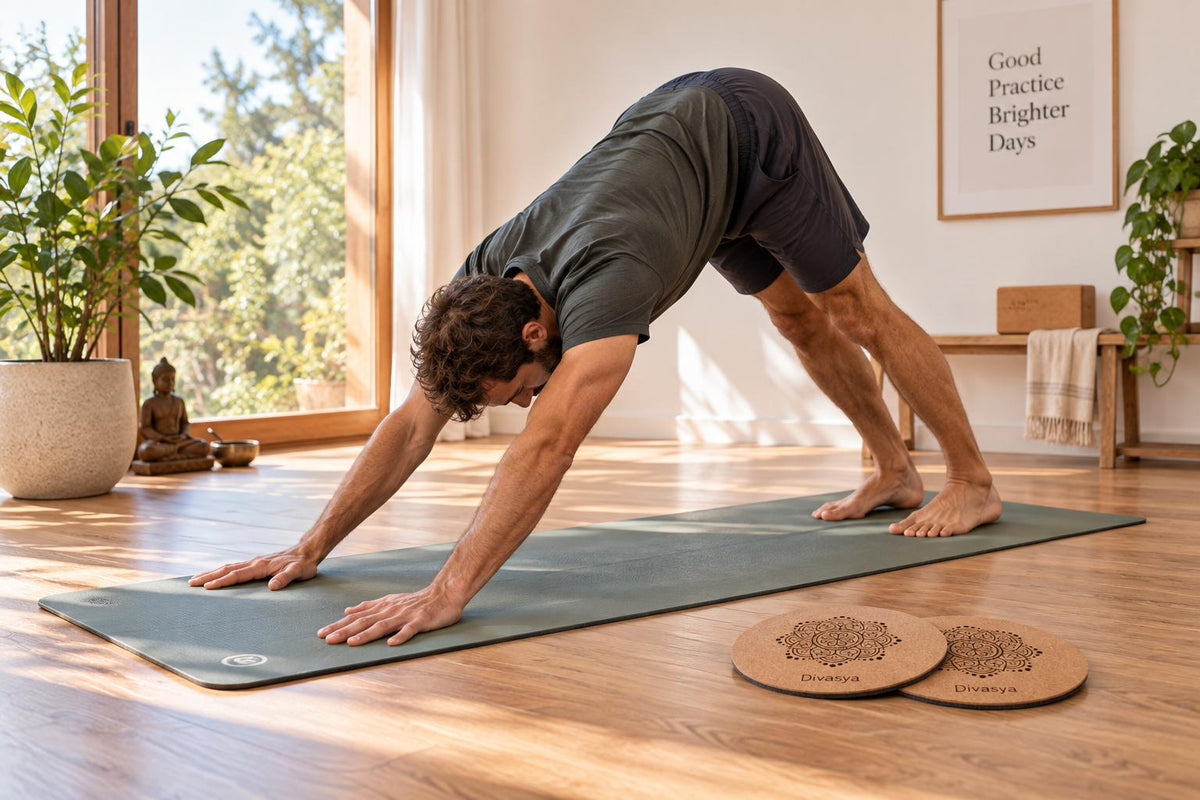
At the latest in downward-facing dog, you'll realize how important a non-slip yoga mat is.
Hands and feet bear a large part of your body weight. If your hands start to sweat and slowly slide forward, it unnecessarily drains your strength. You are then more concerned with holding your position than concentrating on the actual asana and your breath.
The same applies to the surface: the mat itself should lie stably on the floor and not shift during your practice.
A good yoga mat provides grip from both sides: Your hands and feet find grip on the surface, and the mat lies securely on the floor.
This makes your practice more pleasant and gives you the necessary stability and security in standing asanas, balancing poses, and dynamic movement sequences.
What thickness should a good yoga mat have?
There is no single right answer to this. For many yoga practitioners, 4 to 6 mm is a very good range.
A 4mm mat brings you particularly close to the ground. You get direct ground contact and a firm stance. Especially for balancing poses and an active yoga practice, this can feel very good.
A 6mm mat offers a little more cushioning. This can be pleasant if you are more sensitive in your knees and joints or if you prefer to lie a little more comfortably during quiet asanas.
Thicker is not automatically better for a yoga mat.
A very soft, thick surface can even be distracting for balancing poses because direct contact with the ground is lost. Therefore, what matters is how you practice and what feeling you prefer on your mat.
What material should a good yoga mat have?
Yoga mats are made from very different materials. In addition to plastic mats, you will find mats made of natural rubber as well as models with natural materials such as cork or jute.
Many yoga practitioners consciously choose natural materials. Natural rubber offers very good grip, feels firm, and lies flat and stable on the floor due to its higher weight.
However, natural rubber mats are usually heavier and more expensive than plastic mats. They also initially have a typical inherent odor, but this weakens after the first airing and quickly dissipates. Natural rubber is more sensitive and should not be exposed to strong sun or weather conditions for unnecessarily long periods.
If you have a latex allergy, you should take a close look: Natural rubber contains natural latex proteins. Therefore, check the manufacturer's information before buying.
Modern plastic mats can also have very good properties for yoga practice. High-quality materials such as TPE – Thermoplastic Elastomers – combine good grip and stability with a low weight. They are easy to transport and, depending on the material, can be very easy to care for.
With a plastic mat, however, it is worth taking a close look at the material quality. After all, during your yoga practice, you have direct contact with the mat with your hands, feet, and in many asanas, also with your face.
Therefore, pay attention to the manufacturer's information. Is the mat tested for harmful substances? Is it free of phthalates and heavy metals? Does it contain PVC or problematic plasticizers? Is the material recyclable? A recognized certification such as OEKO-TEX Standard 100 can provide additional guidance for appropriately certified mats.
So, plastic is not just plastic. What matters is which material was used and how transparent the manufacturer is about composition, harmful substances, and recycling.
A concrete comparison: plastic or natural rubber – which yoga mat suits you?
Two YOGISTAR yoga mats particularly well demonstrate how differently material, weight, and thickness can affect practice.
YOGISTAR yogimat pro – plastic, light, uncomplicated, and comfortable
The YOGISTAR yogimat pro is made of TPE foam. It is 6 mm thick, 183 × 61 cm in size, and weighs only around 0.95 kg.
Despite its 6 mm cushioning, it is surprisingly light. If you regularly take your mat to the yoga studio, travel by bike, or want to carry it to a class, the low weight quickly becomes noticeable.
At the same time, the Pro offers very good grip and stability – even in more dynamic yoga styles. The closed-cell material prevents sweat and liquids from penetrating the mat and is easy to clean. Both sides can be used for yoga practice. A carrying strap is included in the scope of delivery.
The Pro is PVC- and latex-free, hypoallergenic, and recyclable. According to the manufacturer, by-products generated during production are recycled.
The product packaging also states that it is free of AZO, DOP, phthalates, and heavy metals.
The Pro suits you well if you are looking for a grippy, light, and easy-to-clean yoga mat that you can easily take with you.
YOGISTAR yogimat sun – natural rubber and exceptionally good grip
The YOGISTAR yogimat sun is made of natural rubber and is particularly generously cut with a length of 2 meters and a width of 65 cm. This is pleasant especially for taller people or if you like to have a little more space on your mat. The Sun is available in 4 mm and 6 mm.
Natural rubber has significantly more weight than TPE. However, the Sun lies flat and firmly on the floor and offers exceptionally good grip.
If you prefer a particularly direct ground contact, the 4mm version is interesting. You stand firmly and close to the ground. If you want to combine the feeling of natural rubber with a little more cushioning, you can choose the 6mm version.
Another advantage is the material testing: According to YOGISTAR, the yogimat sun is certified according to OEKO-TEX Standard 100. The manufacturer states that the natural rubber used is tested for unwanted by-products and harmful substances.
However, natural rubber requires a little more attention. Due to its open cell structure, dust, sweat, and signs of use can become visible on the surface more quickly. Direct sunlight should also be avoided for extended periods.
If you transport the Sun regularly, a carrying strap, loop, or yoga bag is a useful addition due to its higher weight.
The Sun suits you well if natural rubber, very good grip, a solid ground feel, and the generous length of 2 meters are particularly important to you.
Do you have knee problems during yoga?
Perhaps you prefer firm ground contact, but your knees would like a little more cushioning during certain asanas. Then you don't automatically have to choose a thicker yoga mat for the entire mat.
A knee pad or yoga pad gives you additional cushioning exactly where you need it. In tabletop position, kneeling positions, or other sensitive pressure points, you simply place the pad on top of your yoga mat.
This way, you maintain the stable feel of your mat and can specifically relieve sensitive areas.
Your yoga mat, your practice
A good yoga mat supports you and provides a safe, stable place for your yoga practice.
When choosing, pay particular attention to grip, ground contact, thickness, and material. If you often take your mat with you, weight also plays an important role. And for plastic mats, it is also worth taking a close look at material quality and testing for harmful substances.
And the color should also suit you: Both the YOGISTAR yogimat pro and the yogimat sun are available in many beautiful colors – so you can choose the color you like to practice on and that matches your aesthetic.


